You read that right. The First 1861 battle of Manassas (Bull Run) ended with the pursuit of the retreating Federals all the way to Washington. Lincoln and his government were captured and a peace treaty was drawn up. The treaty included the ceding of Arizona and the border states to the CSA.
Relations between the USA and CSA fluctuated between cooperation and hostilities converging on another war. However, the Confederate States of Ameriga turned its attention South. There were the campaigns against the Apaches and Commanches. Jefferson Davis authorized the establishment of the Camel Corps and boosted the troops sent to the Cortesian border. Among these were Civilized Indian units from the semi-independent Indian Territory. The Cherokee cavalry under Blue Crow Wattie (grandson of Stan Wattie) was particularly effective, greatly aided by the provision of first Henry and then Winchester rifles.
The other issue was the relationship with Cortesia. Emperor Milo, the Gerolsteiner prince placed there by Blusia, and backed by conservative Cortesians as well as Blusian and Gerolsteiner forces. Even Fezia sent a small force to assist the government forces. At the end of the ACW Confederate 'volunteers' had also crossed the border to assist Emperor Milo. Meanwhile the USA had, through New Cortesia and California, provided the Juaristas with arms and uniforms. Eventually the scale of the rebellion overthrew Milo and foreign forces left. Some of them fled to the CSA. This included some Blusian tailors who found jobs with the Confederate army.
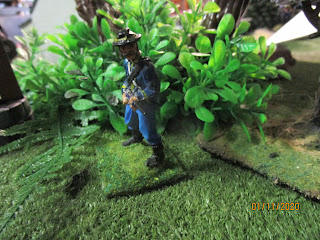
Below can be seen some later 19th century dismounted Confederate cavalry. Uniform and weapon supplies had become much more reliable and uniform but styles are very similar tot he ACW. The slouch hat largely supplanted the kepi. The weapons of choice were the Winchester rifle and Remington revolver. The metal cartridges led to the widespread adoption of canvas looped belts that could be worn at the waist or/and over the shoulders.
Although there was talk of adopting Butternut as the official uniform color the US forces were beginning to adopt a similar color to replace blue uniforms. For this reason Confederate forces retained grey uniforms. Blusian tailors also favored a new style of closer fitting trousers, similar to some European hussar styles. Unlike the US cavalry that were replacing high boots with high canvas gaiters, Confederate cavalry wore high red-brown leather boots. Army branches continued to display branch colors of yellow for cavalry, light blue for infantry, red for artillery and black for medical corps.
On campaign CSA cavalry were, despite more uniform supplies, want to display individual caprice. Option included the shell jacket (influenced both by ACW cut and the Cortesian bandit and vaquero style and often festooned with additional metal decoration). Most outrageously, troopers sometimes wore this unbuttoned with no shirt or undershirt! Some ladies were known to swoon when troopers passed through towns, although officers usually tried to maintain decorum. Alternatively, troopers wore the less colorful and longer coat or just their shirts. Neckerchiefs were often worn to protect the neck from the harsh desert sun or to pull over the face in dusty conditions; they were civilian items and could be any color.


It is an interesting fact that, the Confederate cavalry, in uniform, to some extent, resembled the Cortesian Rurales, although the latter's sombreros still distinguished; even there, sometimes Confederate cavalrymen also donned the very wide brimmed Cortesian hats and even ponchos.
FIGURES
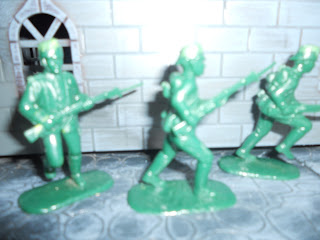
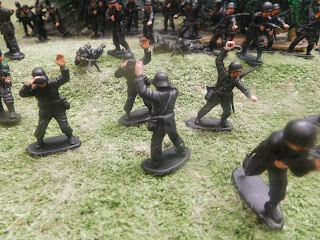
The figures shown are 60mm cheapo Chinese made, basically painted cowboys. They come in boxed sets, sometimes with wagons. Their noses are somewhat sharp and prominent! Most are armed with Winchester rifles and pistols.
Normally if I wanted them as ACW troops I'd trim off the bullet loops on the belts. In the ACW the nearest thing to the Winchester was the Henry rifle but they were not a common weapon, certainly even less so with Confederates.
The figures with ropes I will use as horse holders. You might have noticed the figure with eye patch. I made a mess painting one eye so took the easy path and painted on an eye patch. I have done that before and eye patches look cool. Have more than two in a unit and it will look unduly strange but one or two are plausible.
I also have a new infantry regiment on the bench ready for conversion.
The coming war is between Cortesia and the Confederacy.





For a wild moment there I thought you might have been developing something along the lines of Harry Turtledove's alternate history...
ReplyDeleteSo far. though, an interesting background. I'm inferring that Cortesia is cognate to our world's Mexico? Is this the Mexico ruled by Emperor Maximilian I of Austria? I seem to recall the Confederacy looked with favour upon Maximilian's rule, but perhaps the war is against the Cortesian rebellion... Just thinking out loud, you understand. Sounds like an intriguing campaign whatever it generating circumstances!
Cheers,
Ion
I loved the Turtledove books. They are certainly an influence and might be more so at some time in the future. The premise I have latched onto is that the CSA wins the civil war. I have read many assessments that it could not. However, there were military moments that, if further exploited, at the time, could have led to a Confederate victory. The first major battle the Confederates thrashed Union forces but were too tired to pursue them to Washington. Much is due to chance. If Lee had arrived earlier at Gettysburg it might have been the Federal forces launching against a well positioned enemy.
ReplyDeleteI have played Major Dundee games before. The real cross border incursions in the ACW fascinate me. The Mexican, Belgian, Austrian and French uniforms are a riot of color. I have a number of units painted to represent them.
My own scenario is set later, around 1900, mostly because this is set in a Funny Little Wars one of pseudo and semi-imaginary late Victorian and Edwardian countries. My wargame sparring partner, Mat, and I rolled the dice to decide which countries would go to war. So by chance, on a list of 20 nations or forces this is what appeared.
The scenario could have been the Europeans still in Mexico but I have said they have been kicked out. Otherwise it would, to some extent, be a war between the CSA and Blusia (France).
Paul Wright's Mexican army is called Army-Lime Green. I wanted a name for the country and figured, well Mexico is named after the Mexica but why not named after Hernando Cortez as he is the real founder of the modern nation? I suppose that might even annoy some people as he was the epitome of a ruthless colonialist. He also set in motion, the end of human sacrifice and the blend of Spanish and native that became Mexico.
Anyhow, the FLW armies are based on slightly humorous stereotypes of real nations. I figure that the CSA will have some of the traits of Army Red White and Blue. For example, all non regular units qualities will be unknown until they shoot, get into melee or suffer large casualties. They could be average, 'militia' or elite. In addition the Confederates are going to have the Rebel Yell ability once in the game. All units, that move, then get D 6 extra inches of forward movement and a bonus in melee in contacting an enemy. It is similar to a Warhammer 40K rule for orks!
Other options include making it Steam Punk with steam tanks and walkers or set slightly later with WW1 type tanks. I'll probably not go down those routes this time.
This is not the start of a campaign but just a filler until we get our fantasy campaign up and running again.