What Did 19th Century Cowboys really Look Like?
Like most Australians of my age (I'm 67) we were brought up on Western movies and TV series. What is noticeable is that most of the cowboys were very neatly turned out, more like later 20th century ones who had more access and inclination to bathe change clothes and so on. The Hollywood cowboys also tended to be clean-cut unless they were bad-guys but most good or bad tend to have clean clothes and short back and sides haircuts. This depiction changed a little with the Spaghetti Westerns of Sergio Leone and others. The cowboys started looking dirtier and rougher.
Recently I researched this and, by today's standards, 19th century European and many other people would be considered relatively unclean and smelly. Bathing was not so regular or it was a sponge bath for face hands and strategic areas. On the American Western frontier this was worse as access to water was often rationed. There was also an idea that opening up the pores with immersion made one more vulnerable to infections. Considering that the water was often polluted (I'll get to that) there was something in that. Family members took turns in the bath, sharing the same bath water, even for days. The water might also be used for washing dishes!
Now the above factors can be magnified for cowboys, especially when they were on trail drives that could last months. They might or might not have a change of clothes and they just wore the same things, dry or damp for most of the time. They became infested with body lice, that could be removed from clothing if clothes were placed on an ant hill or boiled. Usually the clothes were not washed any more than the men were.
Water did not always come from crystal clear rivers and streams. In any case men did not want to bathe in frigid Winter water. Water often came from buffalo and cattle wallows where the tadpoles and insects were screened out with dirty socks. The microbes remained.
Meanwhile, tooth brushes were uncommon (although some stage coach stops provided communal ones for passengers). Common foods consumed included tough dried meat and lollies so the teeth were having a hard time. If they had a cook things might be a bit better but fruit and vegetables were not common so men got scurvy and lost teeth. All this is without considering what their breath was like.
Shaving was hazardous as any nicks could get infected so many or most men wore beards. (Incidentally, the Chinese tended to pluck out their hairs).
The Native Americans bathed much more regularly except, probably when living in arid regions. They did not have the Puritan prudish heritage about nudity, either.
On reaching town a cowboy might have a 50c bath, quite expensive for those days. Great, you think. Not so great as often the bath was shared, alternatively, by nine other customers.
Then there were the prostitutes who shared some time with cowboys and also some 'social diseases'.
Often the cowboys slept close together to keep warm so any critters and microbes could swap bodies and 'party.'.
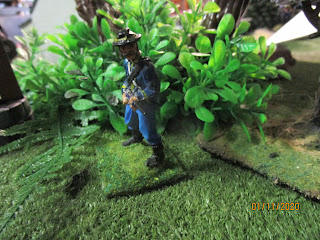
This makes me think of painting my cowboy figures a lot scruffier and also adding beards. Longer hair could also be added with the short back and sides becoming the norm in the late 19th century but on the trail haircuts would not be so available anyway.
One additional thought is that many cowboys were black and Hispanic, something not so common in traditional Western movies.
Clothing would be a combination of dull earthy colors and some bright, especially for shirts and neckerchiefs. Headgear was usually a variety of slouch hat styles but caps and derbies were occasionally also worn. Chaps were often worn for leg protection from scrub. High heeled boots to aid staying in the stirrups and spurs were obvious advantages. Revolvers were an asset but not every cowboy had them. The revolver belt would not have the famous bullet loops until some time after the ACW as metal cartridges were fairly new. Various types of long arms were often carried.
Extending this thought to a history of soldiers, being on campaign certainly reduced the polish. Even Napoleon's grenadiers would have patches and holes in their clothes, especially in the knees and elbows, and probably the odd bit of civilian apparel was worn and so on. As for the U.S. cavalry of the Indian Wars, they plonked many a variation of civilian slouch hat on their heads and different colored civilian neckerchiefs and shirts as well as the issue grey and dark blue ones. I assume they also would have grown beards.





Fascinating.
ReplyDeleteAlan Tradgardland
I have a heavy red wooden haversack that’s travelled through many Mediterranean countries with me, it has now bleached in the sun to a rather interesting pink! It does make you wonder if the British redcoats in Spain may in fact have been pinkcoats but who wants to see that on their war games table.
ReplyDeleteI read somewhere that the rank and file redcoats in the American Revoution became a kind of 'brick red'. However, really pink uniforms would be eye catching and I may do some imagi-nations ones.
ReplyDeleteLarge number of cowboys on cattle drives were in reality black, Mexican or Hispanic, rarely seen in the 1950s 1960s movies and toy cowboys. I found a useful cowboy fact or fiction section inside a 1980s schoolbook and put this inside a Airfix cowboy copy playset (shoebox). Gaudy colours soon faded …
ReplyDelete